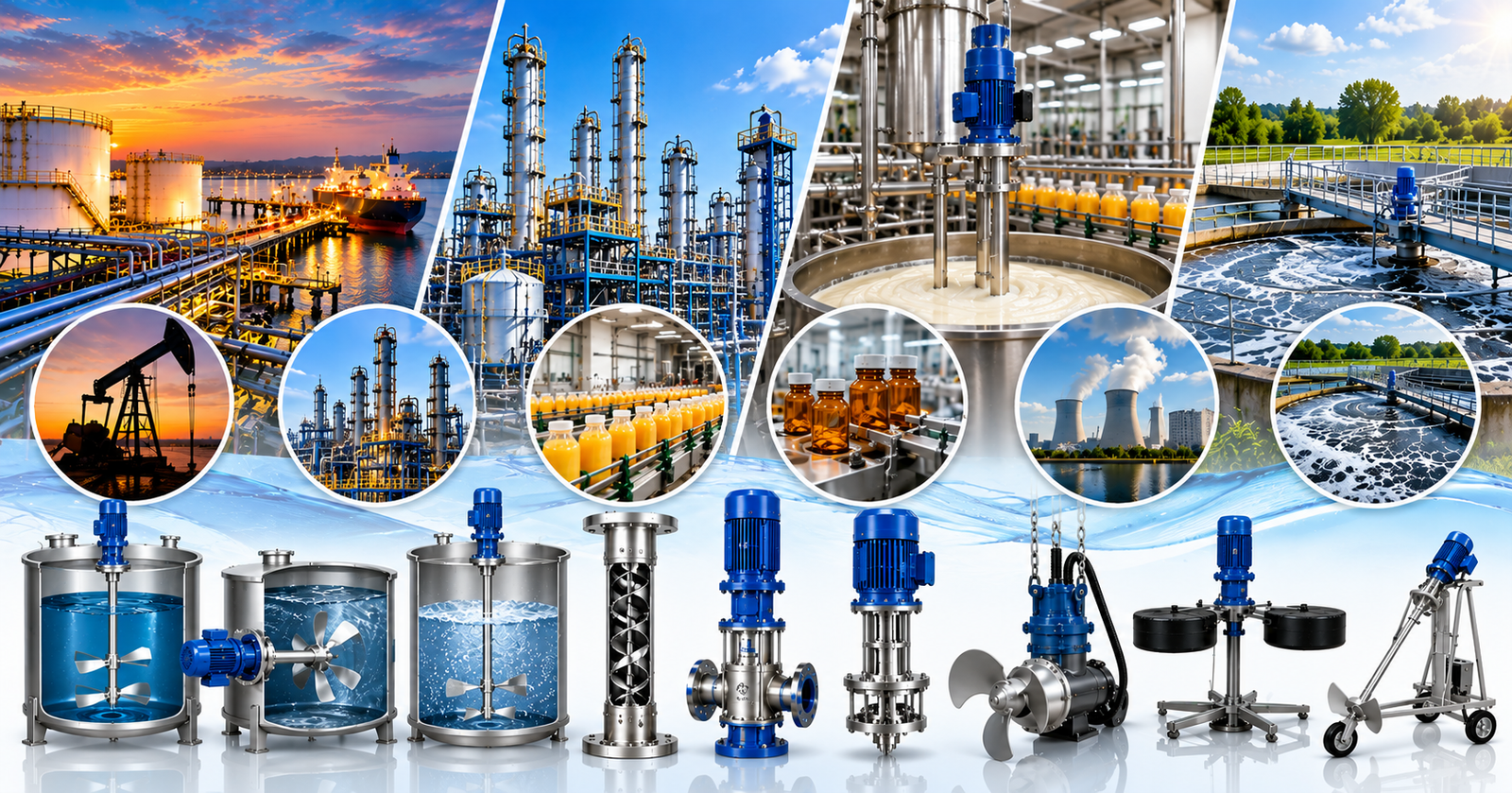
Industrial mixers play an important role in many manufacturing and processing industries. From mixing crude oil in storage tanks to blending chemicals, preparing food products and treating wastewater, different mixing applications require different types of equipment.
The main purpose of an industrial mixer is to combine, circulate or blend materials to achieve the required product quality and process performance.
However,
not every mixer is suitable for every application. The correct mixer depends on the type of liquid, tank size, product thickness, mixing requirements and operating conditions.
1. Why Are Industrial Mixers Important?
Many industrial products contain different liquids, solids or other materials that need to be mixed before they can be processed, stored or used.
Without proper mixing, materials may separate, settle at the bottom of a tank or fail to reach the required consistency.
Industrial mixers help to:
- Maintain a more uniform mixture
- Blend different liquids and ingredients
- Keep solid particles suspended in liquids
- Reduce unwanted settling in storage tanks
- Support chemical reactions and heat transfer
- Improve product consistency and processing efficiency
Different industries use different mixer designs to achieve these results.
2. Top Entry Mixers and Agitators
Top entry mixers are installed on the top of a tank or vessel. A rotating shaft extends into the liquid, with an impeller that moves and mixes the product.
These mixers are widely used because they can be designed for different tank sizes and mixing duties.
Common applications:
- Chemical mixing and blending
- Food and beverage processing
- Pharmaceutical manufacturing
- Water treatment
- Industrial liquid storage
Top entry agitators can be supplied with different impeller designs, motors, gearboxes and sealing arrangements depending on the application.
3. Side Entry Mixers for Oil Storage Tanks
Side entry mixers are installed through the side wall of a storage tank, usually near the lower section.
They are particularly useful for large tanks where mixing from the top may not be practical.
In oil storage depots and petroleum terminals, side entry mixers can help circulate stored products, improve blending and reduce unwanted settling where suitable for the product and tank design.
Common applications:
- Crude oil storage tanks
- Petroleum product blending
- Refinery storage facilities
- Oil terminals and tank farms
Side entry mixers are commonly selected for large-volume liquid storage applications.
4. Bottom Entry Mixers
Bottom entry mixers are installed at the bottom of a tank or vessel.
They are used where mixing close to the tank bottom is important or where the process requires a particular mixing pattern.
Common applications:
- Chemical processing
- Pharmaceutical production
- Food and beverage manufacturing
- Specialised process vessels
The mixer design and sealing system must be suitable for the product, pressure, temperature and cleaning requirements.
5. Static Mixers
Unlike motor-driven mixers,
static mixers have no rotating mixing parts.
They are installed inside a pipeline and use specially designed internal elements to mix materials as they flow through the pipe.
Static mixers are useful for continuous processes where liquids or gases need to be mixed without a separate mixing tank.
Common applications:
- Chemical blending
- Water treatment and chemical dosing
- Oil and gas processing
- Food and beverage production
- Industrial pipeline mixing
Static mixers can provide a simple and compact mixing solution, although they create some pressure loss in the pipeline.
6. Inline Mixers
Inline mixers are installed directly in a process pipeline and provide mixing as the product passes through the equipment.
Depending on the design, inline mixers may use a motor-driven mixing head to create more intensive mixing than a conventional static mixer.
Common applications:
- Chemical processing
- Liquid blending
- Food production
- Emulsion preparation
- Continuous manufacturing processes
Inline mixers are useful where products need to be mixed continuously without relying entirely on a large mixing vessel.
7. Emulsifiers and High-Shear Mixers
Some products contain liquids that do not easily mix, such as oil and water.
Emulsifiers and high-shear mixers are designed to break liquids into smaller droplets and disperse ingredients throughout a mixture.
They are commonly used when a smooth, consistent product is required.
Common applications:
- Sauces, dressings and dairy products
- Creams and lotions
- Pharmaceutical products
- Paints and coatings
- Chemical emulsions
High-shear mixing is particularly useful for emulsification, dispersion and certain homogenisation processes.
8. Submersible Mixers
Submersible mixers operate directly inside the liquid and are commonly installed in tanks, pits and treatment basins.
They help move and circulate liquids and can keep solids suspended where required.
Common applications:
- Wastewater treatment plants
- Sewage treatment
- Industrial effluent tanks
- Sludge mixing
- Equalisation tanks
Submersible mixers are often selected for applications where the mixing equipment needs to operate below the liquid surface.
9. Surface Aerators
Surface aerators are used mainly in water and wastewater treatment.
They move liquid at the surface and help transfer oxygen from the air into the water.
Oxygen is important in many biological wastewater treatment processes because it supports microorganisms that break down waste materials.
Common applications:
- Municipal wastewater treatment
- Industrial effluent treatment
- Biological treatment basins
- Aeration lagoons
Surface aerators are selected when both liquid movement and oxygen transfer are required.
10. Mobile Mixers and Agitators
Mobile mixers are designed for applications where mixing equipment needs to be moved between tanks, containers or production areas.
They can be useful for smaller batches, temporary mixing duties and facilities handling different products.
Common applications:
- Chemical preparation
- Paint and coating production
- Food processing
- Small-batch manufacturing
- Industrial maintenance operations
Mobile mixers offer flexibility where a permanently installed mixer is not necessary.
11. Laboratory Mixers and Emulsifiers
Before starting full-scale production, manufacturers often need to test how different materials behave during mixing.
Laboratory mixers are used for research, product development, testing and small-batch preparation.
Common applications:
- Chemical product development
- Pharmaceutical research
- Food formulation
- Cosmetics testing
- Industrial quality control
Laboratory mixing helps companies evaluate product behaviour and develop suitable processes before moving to larger equipment.
12. Special-Purpose Mixers and Agitators
Some industrial applications require specially designed mixers because of unusual product properties or operating conditions.
These may include thick liquids, abrasive materials, high-temperature products or processes requiring a particular mixing pattern.
Special-purpose mixers can be designed with different impellers, shaft arrangements, materials and sealing systems.
They are used across chemical, petrochemical, food, pharmaceutical and other processing industries.
13. How to Choose the Right Industrial Mixer
Choosing the correct mixer is important for reliable operation and consistent product quality.
Before selecting a mixer, the following factors should be considered:
- Product type: Liquid, slurry, powder-liquid mixture or emulsion
- Viscosity: Whether the product is thin or thick
- Tank size: Mixing volume and vessel dimensions
- Mixing purpose: Blending, circulation, suspension, dispersion or emulsification
- Operating conditions: Pressure, temperature and process requirements
- Materials: Compatibility with the product
- Installation: Top entry, bottom entry, side entry, inline or submersible
- Hygiene requirements: Cleaning and sanitary design where required
Correct mixer selection can help improve product quality, reduce unnecessary energy use and support dependable operation.
14. Industrial Mixing Solutions from Elite Flow Control
Elite Flow Control provides industrial mixers, agitators and emulsification solutions for a wide range of process industries.
Our product range includes top entry mixers, bottom entry mixers, side entry agitators, static mixers, inline mixers, submersible mixers, surface aerators, mobile mixers, emulsifiers, laboratory mixers and special-purpose mixing equipment.
We support customers in Oil & Gas, Refining, Petrochemical, Chemical Processing, Food & Beverage, Pharmaceuticals, Water Treatment and other industrial sectors.
Our technical and commercial support covers equipment selection, material and configuration requirements, operating conditions and project-specific documentation coordination.
We aim to help customers identify suitable mixing equipment for their specific process requirements.
Conclusion
Industrial mixers are essential in many industries, but different applications require different mixing solutions.
A large crude oil storage tank may require side entry mixers, while a food production line may use high-shear emulsifiers. Chemical plants often use top entry agitators, static mixers and inline mixers, while wastewater treatment facilities commonly use submersible mixers and surface aerators.
The right mixer helps achieve the required mixing performance, product consistency and reliable operation.
For industrial mixers, agitators, emulsifiers and static mixing equipment, contact
Elite Flow Control to discuss your application and equipment requirements.