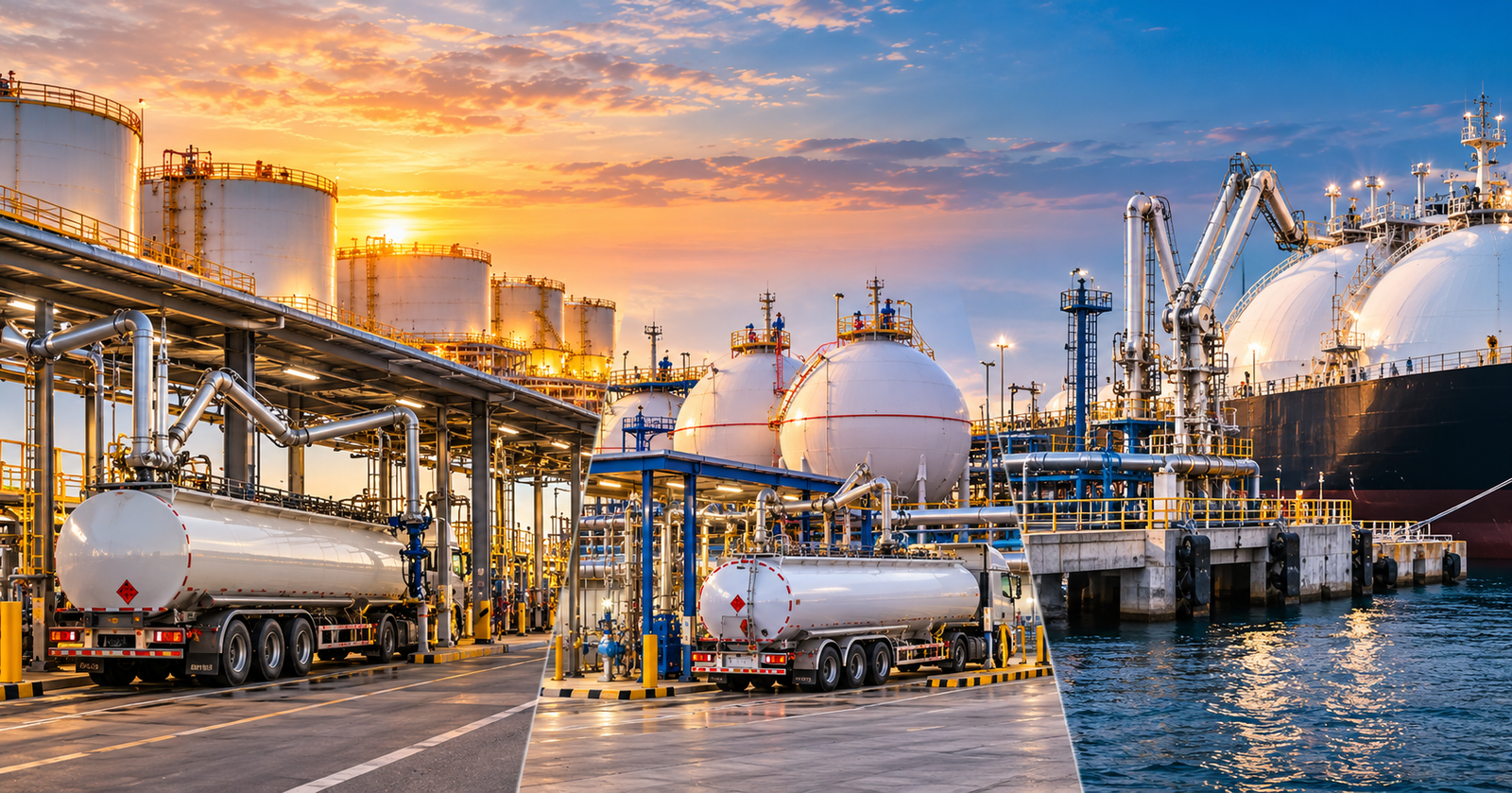
Oil storage depots, LPG stations and LNG terminals handle large amounts of liquids and gases every day. These products must be transferred safely between storage tanks, road tankers, rail tankers and ships.
Loading arms play an important role in making these transfers safer, easier and more efficient. They are widely used in oil and gas facilities, petroleum terminals, chemical plants and other industrial locations where safe fluid transfer is essential.
What Is a Loading Arm?
A loading arm is a specially designed pipe system used to transfer liquids or gases between a fixed pipeline and a tanker or other receiving vessel.
Unlike ordinary hoses, loading arms use rigid pipes with swivel joints that allow movement during connection and operation. They can be designed for different products, pressures, temperatures and loading conditions.
Loading arms are commonly used for transferring petrol, diesel, crude oil, chemicals, LPG, LNG and other industrial liquids.
1. Loading Arms for Oil Storage Depots
Oil storage depots store and distribute petroleum products such as petrol, diesel, kerosene and other fuels. These products are regularly loaded into road tankers and rail tankers for delivery to customers.
Loading arms help operators connect tankers to the depot’s piping system and transfer products in a controlled manner.
Key benefits include:
- Safer and more controlled product transfer
- Easier connection and disconnection
- Reduced manual handling compared with heavy hoses
- Suitable arrangements for top or bottom tanker loading
- Better support for regular loading and unloading operations
Top loading arms transfer products through openings at the top of a tanker, while
bottom loading arms connect to loading points near the lower part of the tanker.
The choice depends on the product, tanker design, loading method and safety requirements of the storage depot.
2. Loading Arms for LPG Stations and Terminals
Liquefied Petroleum Gas (LPG) is commonly used as a fuel for domestic, commercial and industrial applications. LPG storage and distribution facilities transfer the product between storage tanks and road tankers.
Because LPG is stored and transferred under pressure, the loading equipment must be suitable for the operating conditions.
LPG loading arms are designed to provide secure connections for transferring LPG between the terminal and the tanker.
Many LPG loading systems use two separate connections:
- Liquid loading arm: Transfers liquid LPG between the storage system and tanker.
- Vapour return arm: Provides a return path for LPG vapour where required by the loading process.
Using suitable liquid and vapour transfer connections helps support controlled loading and unloading.
Depending on the system design, LPG loading arms may also include emergency release systems, dry-disconnect couplings and other safety equipment.
3. Loading Arms for LNG Terminals
Liquefied Natural Gas (LNG) is natural gas cooled to approximately −162°C so that it becomes liquid. This allows large quantities of natural gas to be stored and transported.
LNG terminals use specially designed loading systems because the equipment must operate at extremely low temperatures.
LNG loading arms are used to transfer LNG between storage facilities and ships or road tankers, depending on the terminal design.
These loading arms require suitable materials, seals, swivel joints and connections for cryogenic service.
Important considerations include:
- Safe handling of very low-temperature LNG
- Suitable materials and insulation arrangements
- Reliable connections during loading and unloading
- Allowance for movement of the tanker or vessel
- Emergency disconnection arrangements where required
Correct equipment selection is especially important for LNG applications because ordinary loading equipment may not be suitable for cryogenic temperatures.
4. Why Are Loading Arms Better Than Ordinary Hoses?
Both loading arms and flexible hoses are used for industrial fluid transfer. However, loading arms can offer important advantages in applications involving frequent loading, heavy connections and demanding operating conditions.
| Loading arms |
Flexible hoses |
| Rigid piping with swivel joints |
Flexible hose construction |
| Can reduce manual handling |
May require more manual handling |
| Designed for repeated loading operations |
Suitable for many transfer applications |
| Can include integrated safety devices |
Safety equipment depends on hose system design |
| Common in permanent loading facilities |
Common in permanent and temporary transfer applications |
The best option depends on the product being handled, transfer frequency, operating conditions and site requirements.
5. Choosing the Right Loading Arm
Not every loading arm is suitable for every application. Before selecting a loading arm, operators should consider the following:
- Product: Petrol, diesel, crude oil, LPG, LNG or chemicals
- Loading method: Top loading or bottom loading
- Connection: Flanged connection, coupling or other suitable connection type
- Operating conditions: Pressure and temperature
- Materials: Compatibility with the transferred product
- Movement: Required reach and working range
- Safety: Emergency release, isolation and other necessary protection systems
Selecting the correct loading arm helps improve day-to-day operations and supports safe, reliable product transfer.
6. How Elite Flow Control Supports Loading Arm Requirements
Elite Flow Control provides fluid transfer solutions for oil storage depots, petroleum terminals, LPG stations, LNG terminals, chemical plants and other industrial applications.
Our loading arm product range covers top loading arms, bottom loading arms, LPG loading systems, LNG loading systems and related fluid transfer equipment.
We support customers with loading arm selection, technical evaluation, material and configuration requirements, connection arrangements and project-specific documentation.
Our aim is to help customers identify suitable equipment based on the product being transferred, operating conditions and applicable technical and safety requirements.
Conclusion
Loading arms are an important part of modern oil storage depots, LPG stations and LNG terminals. They help transfer liquids and gases between storage facilities and transport vehicles in a controlled and efficient way.
Whether used for petroleum products, pressurised LPG or cryogenic LNG, selecting the right loading arm is essential for safe and reliable operations.
Looking for loading arms for your storage depot, LPG station or LNG terminal?
Contact
Elite Flow Control to discuss your fluid transfer requirements and suitable loading arm solutions.